Collection: Narabri Nakamarra

Narrabri Nakamarra Paintings

 Quick Facts: 

  • Date of Birth: c. 1950 (some sources record 1949)

  • Date of Death: June 2010

  • Place of Birth: Haasts Bluff, Northern Territory, Australia

  • Language Group: Pintupi

  • Art Centre: Papunya Tula Artists

  • Style of Art: Contemporary Aboriginal painting, acrylic on linen and canvas, using straight lines for sandhills alongside rock hole and ceremony imagery

  • Aboriginal Art Status: Established Papunya Tula artist, painting in her own right from 1999

  • Themes: Lupulnga (women's ceremonial site), Women's Ceremony, Pilrili (My Country), Payarrnga (Rock Holes), Tali (Sandhills)

  • Family: Daughter of Makinti Napanangka; sister of artists Ginger Tjakamarra and Jacqueline; sister-in-law of Ngoia Pollard Napaltjarri

Narrabri Nakamarra was a Pintupi artist who painted with Papunya Tula Artists, the daughter of the celebrated Makinti Napanangka and part of one of the great painting families of the Western Desert. Every Narrabri Nakamarra painting draws on the women's ceremonial Country of her mother's line, and her work stands as a rich example of Aboriginal art shaped by inheritance, close observation and a growing personal style.

 Early Life & Family 

Narrabri Nakamarra was born around 1950 at Haasts Bluff, west of Alice Springs, and her family soon moved to Papunya. Her parents were part of the large group of Pintupi people who walked in to Haasts Bluff in the early 1940s, at a time when contact with outsiders was only beginning. She passed away in June 2010.

Narrabri's mother was Makinti Napanangka, one of Australia's most influential Aboriginal painters and the winner of the 2008 Telstra Award, whose work was widely regarded as among the most collectable of any living Aboriginal artist before her death in 2011. Narrabri's siblings Ginger Tjakamarra and Jacqueline also became artists with Papunya Tula Artists. Her sister-in-law, Ngoia Pollard Napaltjarri, won the Telstra Award in 2006, meaning two members of the same extended family were recognised by the award in consecutive years. Narrabri grew up, and later painted, within this deeply artistic household.

 Learning to Paint 

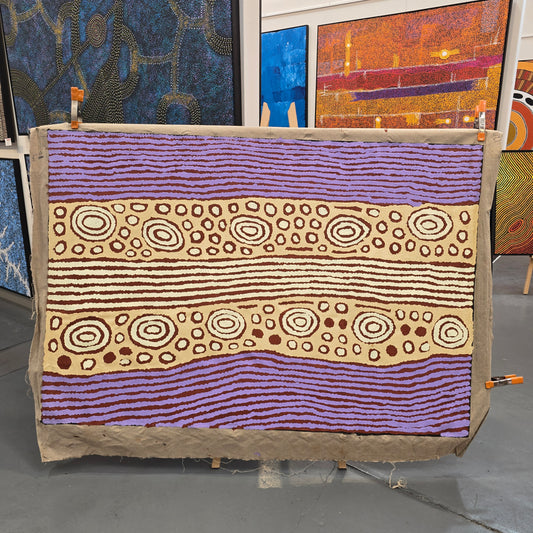
Narrabri first began painting by assisting her mother with her artworks, at a time before Makinti's successful eye operation, when help with her large canvases was especially valuable. She commenced painting in her own right in 1999, working across a diverse range of Dreamings and often in noticeably different styles. Her paintings frequently show the influence of the artists she had watched and worked alongside.

 Dreaming Stories & Style 

Narrabri's style was strongly shaped by her mother's, particularly her use of straight lines to represent sandhills, and her exploration of themes connected to Lupulnga, the women's ceremonial site of which Makinti is custodian. Over time, however, she developed a distinctive style of her own. Her work ranges across Women's Ceremony, her own Country (Pilrili), rock holes (Payarrnga) and sandhills (Tali), often in deeply layered compositions. Anyone browsing Aboriginal artwork with a strong sense of the Western Desert women's tradition will recognise the ceremonial focus running through her paintings.

 Significance & Legacy 

Narrabri Nakamarra's significance lies in the way her work carries forward Makinti Napanangka's Country and ceremonial knowledge into a second generation, while showing a painter finding her own voice. Her paintings connect one of Papunya Tula's most important women's ceremonial sites, Lupulnga, to a new body of work, and offer collectors a chance to engage with that lineage through the hand of a family member rather than only through the founding artist.

Narrabri's career was cut short by her death in 2010, only eleven years after she began painting in her own right. What remains is a focused body of work that documents both her mother's influence and her own developing style, and that continues to represent the women's ceremonial traditions of Lupulnga and the surrounding desert Country.

Narrabri's paintings were included in a number of exhibitions during her career:

  Artworks & Exhibitions  

Papunya Tula Artists: A Gift from the Desert, Utopia Art, Sydney, 2003

Redlands Westpac Art Prize, Mosman Art Gallery, Sydney, 2004

New Ideas, Utopia Art, Sydney, 2005

Rising Stars, Gabrielle Pizzi Gallery, Melbourne, 2005

New Works from the Western Desert, Indigenart, Perth, 2005

Paintings by Papunya Tula Artists, Suzanne O'Connell Gallery, Brisbane, 2006

Rockholes and Claypans, Red Desert Gallery, Eumundi, 2009

Amazing Women of the Desert, Central Art

 Documented Narrabri Nakamarra artworks include: 

Women's Ceremony (2008), acrylic on canvas, 205 x 198 cm

Trio: My Country (Pilrili) / Rock Holes (Payarrnga) / Sandhills (Tali) (2005), 120 x 165 cm

 Shop the Collection 

Every artwork in this collection is created by Aboriginal artists with the cultural authority to paint these stories, supporting artists and their communities directly. Explore a Narrabri Nakamarra painting and other Aboriginal art at Mandel Aboriginal Art Gallery, backed by clear provenance and a direct connection to Country.

Contact us for more details.