Collection: Mitjili Napurrula
-
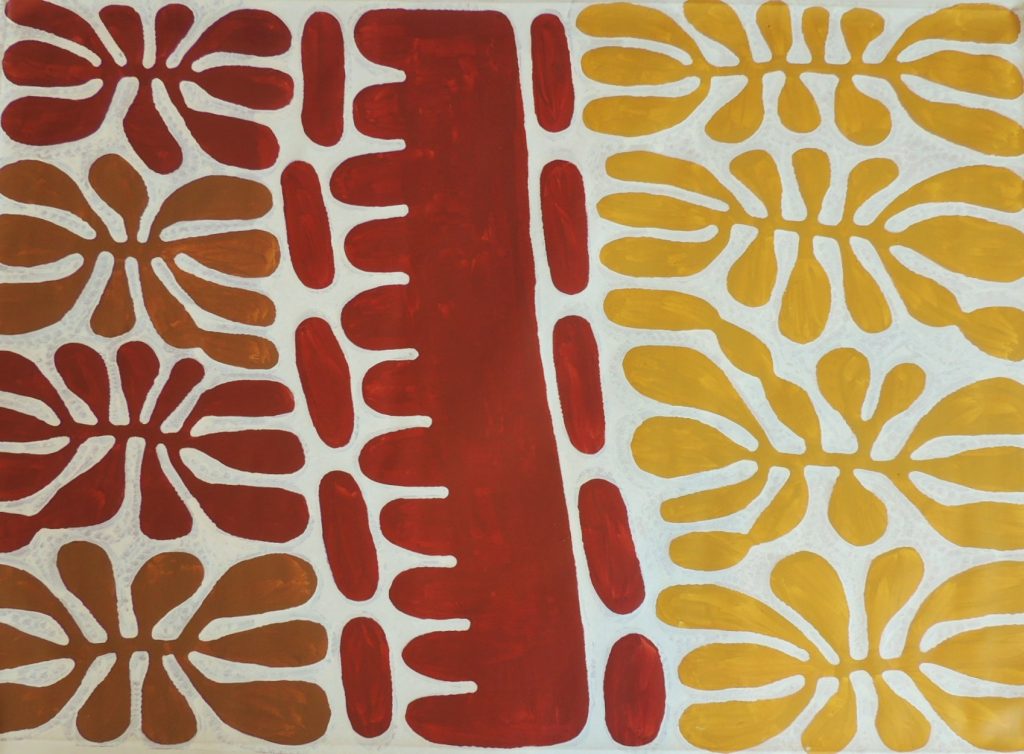
Mitjili Napurrula 88cm x 125cm
CODE : 4912Vendor:Mitjili NapurrulaRegular price $4,500.00 AUDRegular priceUnit price / perSale price $4,500.00 AUD
Quick Facts
- Full Name: Mitjili Napurrula (also respectfully referred to posthumously as Kumuntjai Napurrula)
- Born: 1945
- Died: April 2019
- Place of Birth / Origin: Papunya, Northern Territory, Australia
- Community: Haasts Bluff (Ikuntji) and Mount Liebig, Northern Territory
- Language Group / People: Pintupi / Luritja
- Father: Tupa Tjakamarra
- Mother: Tjunkiya Napatljarri (Tjunkayi Napaltjarri), Pintupi/Luritja woman from Yumari
- Brother: Turkey Tolson Tjupurrula, founding member of Papunya Tula Artists
- Husband: Long Tom Tjapanangka, senior Papunya Tula artist
- Painting Since: 1992
- Art Centre: Ikuntji Artists Aboriginal Corporation, Haasts Bluff
- Main Themes: Watiya Tjuta (Desert Oak / Spearwood Trees), Kulata (Spear) Dreaming, Ilyingaungau Country
- Primary Medium: Acrylic on canvas and linen
Mitjili Napurrula was a Pintupi/Luritja artist whose Mitjili Napurrula painting practice became one of the most instantly recognisable in Western Desert Aboriginal art, Working from Haasts Bluff, she built an international reputation for her bold, rhythmic depictions of Watiya Tjuta, the desert oak and spearwood trees central to her father's Tjukurrpa, translating a story of spear-making and Country into some of the most striking Aboriginal artwork to emerge from the Ikuntji art movement.
Early Life
Mitjili was born in 1945 at Papunya, around 200 kilometres west of Alice Springs. Her mother, Tjunkiya Napatljarri, was a Pintupi/Luritja woman from Yumari who had come in from drought-stricken Country seeking refuge and rations at Haasts Bluff (Ikuntji), settling with her extended family at Papunya, where Mitjili was born. Dispossession and drought were among the many factors that drove a series of migrations from the desert into mission and government settlements across the mid-twentieth century, and Mitjili's family history reflects this broader upheaval directly.
Mitjili grew up at Papunya during the years the Papunya Tula art movement itself was taking shape around her, with members of her own family playing a central role. Her brother, Turkey Tolson Tjupurrula, was one of the founding members of the Papunya Tula Artists cooperative, and her husband, Long Tom Tjapanangka, became a major artist within the same movement. In the late 1980s, during the broader outstation movement, Mitjili and Long Tom moved to Haasts Bluff.
Artistic Journey
Mitjili began painting in 1992, when the Ikuntji Women's Centre opened at Haasts Bluff, with both Mitjili and her husband contributing significantly to the art movement that grew from it. Her international reputation was cemented in 1999, when she won the Alice Springs Art Prize (the Alice Prize) for her painting Untitled (1999), a win that brought her a wide following well beyond Australia.
Mitjili's paintings depict Watiya Tjuta, the desert oak and spearwood trees, at times interspersed with red sandhills, forming harmonious images of her father's Country at Uwalki, near the Kintore Ranges. This is a Tjukurrpa she inherited through her mother rather than being taught directly by her father: as Mitjili herself described it, "After I got married, my mother taught me my father's Tjukurrpa in the sand, that's what I'm painting on the canvas," her mother drawing the key motifs in the traditional way before Mitjili translated them onto canvas. Her repeated tree motifs represent the women's side of this Tjukurrpa, depicting the very trees used as the source of wood for kulata, or spear shafts.
Artworks
At the centre of Mitjili's Aboriginal art is Ilyingaungau, a site in the Gibson Desert south of Walungurru (Kintore), around 520 kilometres west of Alice Springs. This is where her Mutikatjirri ancestors are said to have assembled their kulata for a conflict with the Tjukula men, and it is her father's Tjukurrpa, shared with her brother Turkey Tolson Tjupurrula, who inherited the same right to paint it from their shared father, Tupa Tjakamarra. Where Tjupurrula's own celebrated paintings often reference the straightening of kulata, Mitjili's works focus on the Watiya Tjuta themselves, the standing trees of this Country.
Stylistically, Mitjili's paintings are built from tightly structured, rhythmic patterning and a bold, confident use of colour. In her prize-winning Untitled (1999), coagulated white pigment eddies around abstract tree forms, a visual signature that demonstrated her individual artistic vision within a family of celebrated Papunya Tula and Ikuntji painters. Her Watiya Tjuta design has also lived on beyond canvas, extended by Ikuntji Artists into textiles, clothing and homewares under the Ikuntji Textiles project, carrying her design into an entirely new context for a new generation of admirers.
Exhibitions
Mitjili built an exceptionally extensive exhibition record across three decades, with her work shown across Australia and internationally:
Collapsible content
Solo exhibitions at Niagara Galleries, Melbourne (1997, 1999 and 2000), Kate Owen Gallery, Sydney (2008), and a dedicated solo show, Watiya Juta, at Michell Fine Art, Brisbane (2018), focused on the ancient ritual of spear-straightening central to her Tjukurrpa.
Major group exhibitions across Australia, including the Art Gallery of New South Wales (1993), the Art Gallery of South Australia (1999 and 2000), the Museum and Art Gallery of the Northern Territory, Darwin, and the Araluen Arts Centre, Alice Springs, appearing regularly at the latter from 1994 through the late 1990s.
International exhibitions across Germany, Sweden, Denmark, the Netherlands, Italy, Singapore and China through the 1990s and 2000s, including the AAMU Museum of Contemporary Aboriginal Art in Utrecht, where her work featured as part of the permanent collection from 2001 to 2017, and the National Museum of Ethnology in Leiden, Netherlands, which holds her work in its permanent collection.
Posthumous recognition, with her Watiya Tjuta design featured in international runway presentations including New York, London, Paris and Dublin Fashion Weeks through the Ikuntji Textiles collaboration, and her paintings included in the major touring exhibition Three Echoes: Western Desert Art, shown at galleries across Australia from 2022 through 2026.
Awards and recognition, including the 1999 Alice Prize, finalist placement in the National Aboriginal and Torres Strait Islander Art Award (NATSIAA) in 1995 and 1997, the 1996 Heritage Award in Canberra, and further Northern Territory and Australian Heritage Art Award recognition in 1993 and 1994.
Legacy and Role
Mitjili Napurrula's collections today include the National Gallery of Australia, the National Gallery of Victoria, the Art Gallery of New South Wales, Flinders University Art Museum, the Museum and Art Gallery of the Northern Territory, Artbank, and international collections including the Kaplan and Levi Collection in Seattle and the Fondation Burkhardt-Felder Arts et Culture in Switzerland, a footprint few artists of her generation achieved.
Mitjili continued to live and paint at an outstation close to Papunya in her later years, working alongside family and fellow artists such as Ann Lane née Dixon, before passing away in April 2019. Her legacy endures both through her paintings, held in major public collections worldwide, and through the continuing Ikuntji Textiles program, which keeps her distinctive Watiya Tjuta design in active use today. As the daughter, sister and wife of major figures in the Papunya Tula and Ikuntji art movements, and as a celebrated artist in her own right, Mitjili Napurrula holds a significant place in the history of contemporary Aboriginal art.

Discover Authentic Aboriginal Art
If you are interested in collecting authentic works by Mitjili Napurrula or other respected Pintupi and Luritja artists, Mandel Aboriginal Art Gallery offers a carefully curated selection sourced from reputable Aboriginal-owned art centres and trusted galleries.
Whether you are beginning your collection or adding to an established one, Mandel Aboriginal Art Gallery provides genuine Indigenous artworks that honour Australia's rich cultural heritage while supporting Aboriginal artists and their communities.
Contact us for more Aboriginal paintings and dreamtimes.