Collection: Lindsay Bird Mpetyane

Lindsay Bird Mpetyane Paintings

Quick Facts

  • Full Name: Lindsay Bird Mpetyane (skin name also spelled Mbitjana)

  • Born: c. 1935

  • Place of Birth / Origin: Mulga Bore, near Utopia, Northern Territory, Australia

  • Country: Ilkawerne, Utopia region, Central Australia

  • Language Group / People: Anmatyerre

  • Wife: Mavis Petyarre

  • Daughters: Rosie, Jessie and Karen Bird Ngale

  • Family Connections: Cousin to artist Greeny Petyarre; brother-in-law to artist Ada Bird Petyarre

  • Painting Since: Began with batik in 1977; moved to canvas painting in 1987

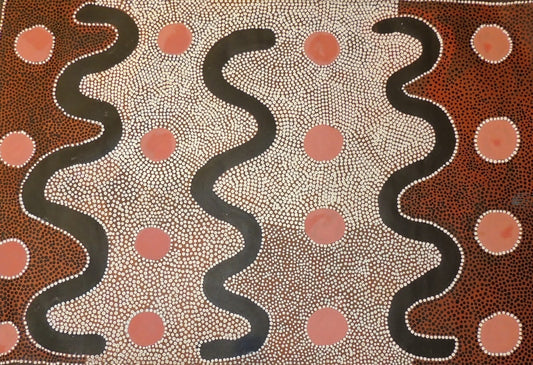
  • Main Themes: Charpa (Honey Ant), Men's Ceremony, Yam Dreaming, Snake Dreaming, Bush Plum, Mulga Tree, Bloodwood Tree, Woomera

  • Primary Medium: Acrylic on canvas, with a distinctive underpainted ground of grey or ochre.

Lindsay Bird Mpetyane is one of the respected Australian Aboriginal artists and  Anmatyerre elder, a tribal leader from Ilkawerne in the Utopia region of Central Australia, and one of the most significant male artists to emerge from the Utopia art movement. Born around the 1930s at Mulga Bore, Lindsay spent much of his life as a shepherd and stockman before becoming, remarkably, the only male participant in the renowned Utopia Women's Batik Group of the late 1970s and 1980s.

Early Life and Leadership

Lindsay was born around the 1930s at Mulga Bore, near Utopia in the Northern Territory. Before turning to art, he worked for many years as a shepherd and stockman across the surrounding stations. As he grew older, Lindsay held standing as an important tribal leader of his Country, Ilkawerne, carrying responsibility for the lore and ceremonial knowledge of his people. In time, and as his own capacity to lead began to wane, he chose a successor to carry that leadership and cultural teaching forward into future generations, driven by a wish to see his community's culture and history endure.

Lindsay married Mavis Petyarre, and the couple had three daughters, Rosie, Jessie and Karen Bird Ngale. He was also closely connected to other prominent Utopia artists, as a cousin of Greeny Petyarre and brother-in-law to Ada Bird Petyarre.

Artistic Journey

In 1977, Lindsay was introduced to painting on silk batik alongside a group of women at Utopia, taught by Pitjantjatjara artist Yipati from Ernabella and craft instructor Suzie Bryce, with further training and materials later provided by Jenny Green and Julia Murray. This grew into the Utopia Women's Batik Group, which at its height involved up to 80 members and became a celebrated source of contemporary Aboriginal art both in Australia and overseas. Lindsay remained the only male participant throughout the batik movement.

When the Utopia artists moved to painting on primed, stretched canvas in 1987 or 1988, Lindsay took to the new medium with the same enthusiasm he had shown for batik, working alongside fellow Utopia artists including Gloria Petyarre, Ada Bird Petyarre and Louie Pwerle. He has been associated with Mbantua Gallery since 1985, producing his first painting for the gallery, Snake Dreaming, in 1987, a work still held in the Mbantua collection today.

Style and Themes

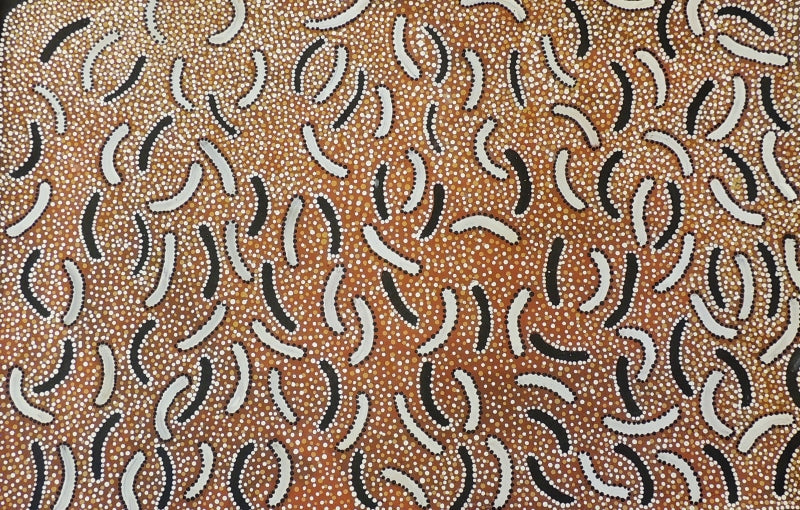
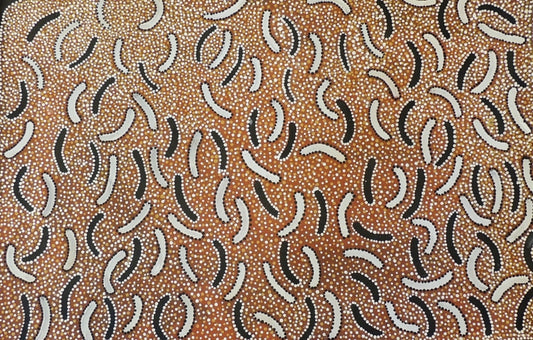
Lindsay's paintings are recognised for their distinctive underpainted ground, typically laid down in grey or ochre before the finer linear and dotted work is added, giving his canvases a striking, immediately recognisable quality. His Dreamings include Charpa (Honey Ant), Men's Ceremony, Yam Dreaming and Snake Dreaming, along with bush foods and plants of his Country such as Bush Plum, Mulga Tree and Bloodwood Tree, and traditional hunting implements including the Woomera.

A recurring theme throughout his work is the depiction of sacred ceremonial sites associated with Men's Business, often rendered in a circular composition surrounded by hunting weapons that stand as spiritual guardians of the site. Though simple in design, these works carry considerable cultural weight, reflecting Lindsay's deep respect for the ceremonies they represent.

Beyond his own painting practice, Lindsay played an important role as a source of cultural knowledge, helping document and pass on the traditions of his culture to a wider audience. With his permission, his cultural teaching was recorded on DVD by the Mbantua Media Department, a recording later presented as a gift to His Royal Highness the Prince of Wales during his 2005 tour of Australia.

Artistic Legacy

Lindsay Bird Mpetyane's paintings are held in major public and private collections across Australia and internationally, including the:

Collapsible content

National Gallery of Australia

The National Gallery of Victoria

The Art Gallery of Western Australia

The Art Gallery of New South Wales

The Queensland Art Gallery

The Museum and Art Gallery of the Northern Territory

The Powerhouse Museum

Parliament House Canberra

The Holmes à Court Collection in Perth

His work has also been exhibited internationally, including at the Royal Hibernian Academy in Dublin and in touring exhibitions of Utopia batik works through Ireland and Scotland.

As one of the founding figures of the Utopia art movement and a respected tribal elder, Lindsay's legacy extends well beyond his paintings, reflected in the generations of Utopia artists who have continued to paint the Country and stories he helped bring to canvas.

Discover Authentic Aboriginal Art

If you are interested in collecting authentic works by Lindsay Bird Mpetyane or other respected Utopia artists, Mandel Aboriginal Art Gallery offers a carefully curated selection sourced from reputable Aboriginal-owned art centres and trusted galleries. Whether you are beginning your collection or adding to an established one, Mandel Aboriginal Art Gallery provides genuine Indigenous artworks that honour Australia's rich cultural heritage while supporting Aboriginal artists and their communities.