Collection: Julie Woods Baker

Julie Woods Baker Paintings

Quick Facts:

Date of Birth: 1980
Place of Birth: Kanpi, APY Lands, South Australia
Language Group: Pitjantjatjara
Style of Art: Contemporary Aboriginal painting
Aboriginal Art Status: Renowned contemporary Indigenous Australian artist
Connection: Strong spiritual and ancestral ties with the Pitjantjatjara people
Artistic Focus: Visual maps of origin and the natural world, blending ancient traditions with modern aesthetics
Current Residence: Kanpi, northwest South Australia

Cultural Heritage and Early Life

Julie is a resident of the Utopia region of the Northern Territory, the home of some of the most important Indigenous artists in Australia (including Emily Kame Kngwarreye). She grew up in a society where art and storytelling are key elements of social and spiritual existence, and was immersed in the Dreaming stories that have undergone generations.

Her art career was influenced by two important Central Desert artists: Maringka Baker, her grandmother, a senior elder and world-renowned artist whose works are displayed in the National Gallery of Australia. Julie was taught the sacred law and Dreaming stories of their country by Maringka, who was her main guide. Her mother, Elaine Woods, is a highly regarded painter who further honed Julie's technical skills, showing her the importance of colour and composition in telling stories.

Her family history is firmly entrenched in artistic skills and the religious symbols and traditional techniques of expressing the Tjukurpa (Dreamtime). Today, Julie frequently paints with her sisters, Janice, Venita, and Cassey and continues a family creative cooperative tradition, which is a core element of Anangu culture.

Artistic Style and Themes

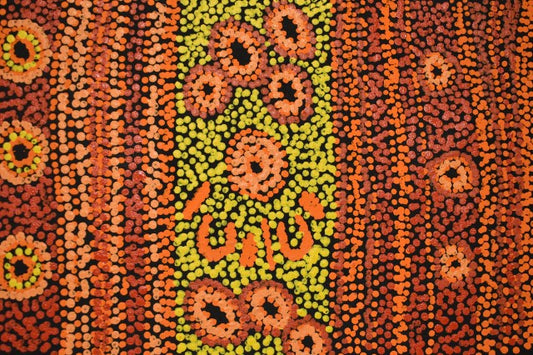
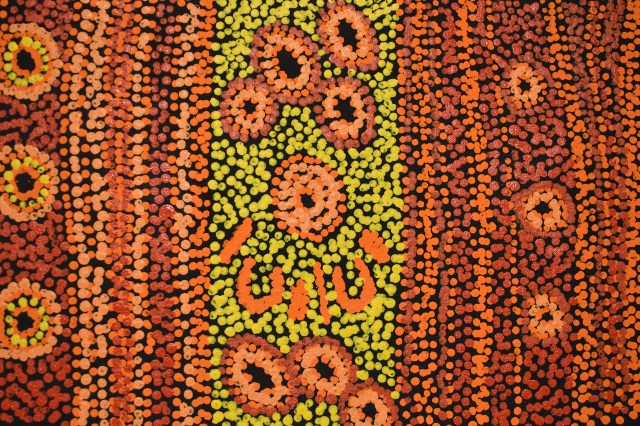
Julie Woods Baker is best known for her complex portrayals of the Bush Medicine Leaf and the Bush Onion. In contrast to some conventional dot paintings, which are fixed to the surface, much of the work by Julie has sweeping rhythmic strokes of the brush that resemble the movement of wind between leaves. Her paintings tend to look like aerial views of the desert, a combination of classical iconography and a contemporary high-contrast image. Her paintings are distinguished by her “shimmer effect”, a technique consisting of fine dotting in different colours, producing an effect of movement, a reflection of the heat haze and spiritual vibration of the land.

Though she appreciates traditional ochre colours, she frequently uses modern acrylics, including deep purples, bright oranges, and bright green, to make her narrations vibrant. She uses a layering effect that creates the illusion of three-dimensional depth and makes the viewer appear to be walking into the landscape.

The Minyma Kutjara (Two Sisters) Dreaming

The Minyma Kutjara Tjukurpa, or the Two Sisters creation story, is the core of the Julie portfolio. The story is a prehistoric tale of two sisters who are on their way to Docker River in the desert, which is in the process of being formed by them.

In her work, Julie illustrates the physical and emotional voyage of the sisters who are going back to the land they belong to. The elder sister educates the younger one on the country, song lines, and sacred ceremonies. The formation of hills, valleys, and water sources that exist today is a result of their travels.

The "Bush Medicine" Dreaming

A central theme in Julie’s work is the Bush Medicine Dreaming. This story celebrates the healing properties of the native flora found in the Central Desert. Women collect the leaves of the bean shrub to create medicinal poultices and oils.

The art honours the ancestral spirits who provided this knowledge to the Anmatyerr people. In her paintings, the repetitive, flowing lines represent the leaves scattered across the ground, symbolising the abundance and healing power of the Earth.

Significance and Legacy

The work of Julie Woods Baker has been displayed in many galleries, both in Australia and other parts of the world. Her capability to express complicated spiritual theories with her visual language that appeals to the global community has seen her become one of the central figures of the Utopia Art Movement.

Through her current painting of her Dreamings, she makes sure that the ecological experience and spiritual history of the people of Anmatyerr will always be alive and visible even in the 21st century.

Julie has managed to establish a bridge between classic fine art and world design. Her original patterns have been used in Fair Trade projects, in which her designs have been hand-embroidered by Kashmiri workers to make luxury fabrics.

Julie Woods Baker Paintings

Engage with Julie alongside the Mandel Aboriginal Art Gallery

Julie Woods Baker is a representative of the generational group of Indigenous artists who are defining Australian art at their own level. She respects culture through her work and engages in the present.
Her art is not necessarily about her origin, but it is a future of Indigenous art in Australia. Work that is thoughtful, grounded, and quietly enduring, Julie can provide that, as the audience will and will continue to demand deeper and more meaningful connections with art.
Seek out her masterpieces with Mandel Aboriginal Art Gallery. Contact us at (03) 9497 5111 or visit us for a detailed look at Julie Woods Baker’s vibrant pieces.

Shop Authentic Art