Collection: Glenys Gibson Napaltjarri
-
Sold outGlenys Gibson 970 mm x 1440 mm
CODE : 9467Vendor:Glenys Gibson NapaltjarriRegular price $3,900.00 AUDRegular priceUnit price / perSale price $3,900.00 AUDSold out -
Glenys Gibson Napaltjarri 960 x 1100mm
CODE : 6984Vendor:Glenys Gibson NapaltjarriRegular price $1,900.00 AUDRegular priceUnit price / perSale price $1,900.00 AUDSold out
Quick Facts
- Date of Birth: 1968
- Place of Birth: Papunya, Northern Territory
- Language Group: Pintupi/Luritja
- Skin Name: Napaltjarri
- Region: Papunya and Kintore (Walungurru), Northern Territory
- Style of Art: Contemporary Western Desert dot painting, exploring Tjukurrpa and women's ceremony
- Notable Recognition: Mosman Art Prize finalist, 2019 and 2020
- Family: Daughter of the late Ningura Napurrula and Yala Yala Gibbs Tjungurrayi
Glenys Gibson Napaltjarri is a Pintupi/Luritja artist born in 1968 at Papunya, in Central Australia, roughly 240 kilometres northwest of Alice Springs. She now divides her time between Papunya and the Kintore (Walungurru) community, where she lives with her husband and extended family.
Family and Artistic Beginnings
Glenys comes from a family deeply woven into the history of the Western Desert art movement. She is the daughter of the late Ningura Napurrula, one of the most celebrated Aboriginal painters in Australia, and of Yala Yala Gibbs Tjungurrayi, also an artist of note.
Growing up alongside the founding male painters of the Papunya Tula Art Centre, Glenys observed their work closely, but it was her mother and the senior women of her family, her aunties and grandmothers, who shaped the artistic voice she eventually made her own. She has been painting professionally since the mid-2000s.
Themes and Stories
Glenys's paintings draw on Tjukurrpa, the ancestral law and creation stories passed to her through her mother's line, particularly the Pintupi Tingari narratives associated with women's ceremony.
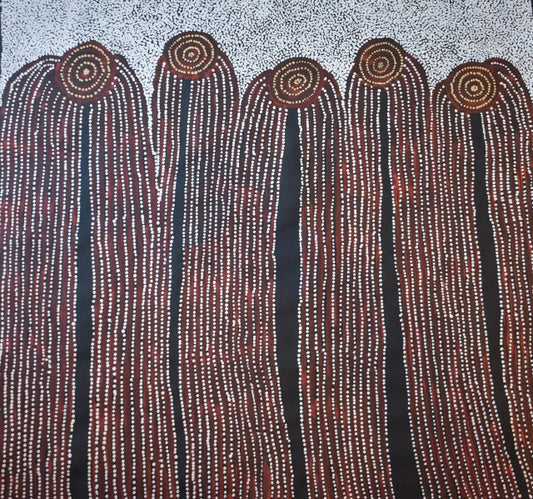
Her best-known body of work centres on the Women's Ceremony, a sacred birthing rite in which a newborn is held near a fire and bathed in its smoke to ward off spirits said to inhabit a nearby salt lake. Tradition holds that only the child's mother, grandmother, and aunties are present for the ceremony itself, while the other women of the community withdraw to gather bush food until it concludes.
Glenys also paints Country associated with her grandmother, carrying her own skin name, Napaltjarri, into work, depicting land to the east of Kirriwurra.
Recognition
Glenys's work has been exhibited across Australia, and she was a finalist in the Mosman Art Prize in both 2019 and 2020, cementing her standing as a significant voice among artists working within the Western Desert art tradition.
Style
Glenys typically works in a restrained palette, often built around black or deep, dark grounds set against bands of dark red and thick lines of white or ochre-toned dots. Concentric circles recur throughout her paintings, representing rockholes and sacred women's sites, linked by lines that trace the ancestral paths connecting one site to the next. U-shaped forms and other symbols throughout her compositions represent women gathered on Country or collecting food, giving her paintings a strong sense of gathering and ceremony even at a distance.
Dive Deep into Glenys Gibson’s Art with Mandel
Explore original paintings by Glenys Gibson Napaltjarri and other leading Western Desert artists at Mandel Aboriginal Art Gallery, or contact us to discuss a piece for your home or collection.