Collection: Freda Price Pitjara
-
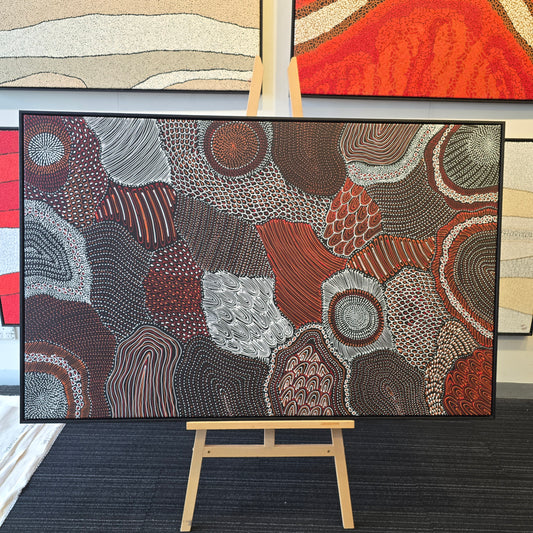
Freda Price 900 mm x 1300 mm
CODE : 7931Vendor:Freda Price PitjaraRegular price $2,700.00 AUDRegular priceUnit price / perSale price $2,700.00 AUD -
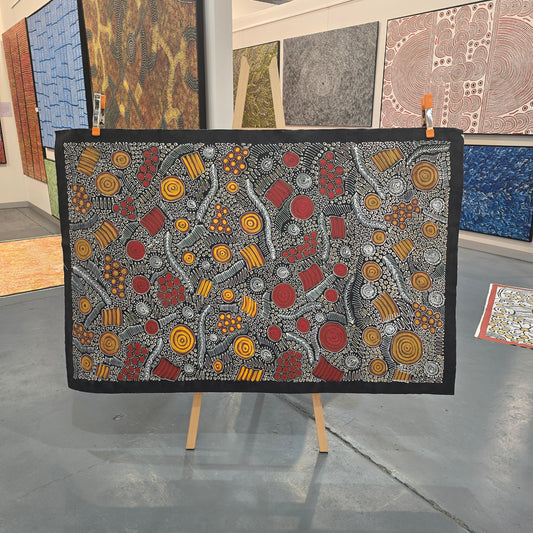
Freda Price 960 mm x 1550 mm
CODE : 7527Vendor:Freda Price PitjaraRegular price $2,900.00 AUDRegular priceUnit price / perSale price $2,900.00 AUD -
Freda Price Pitjara 950 mm x 1500 mm
CODE : 8149Vendor:Freda Price PitjaraRegular price $2,900.00 AUDRegular priceUnit price / perSale price $2,900.00 AUD -
Sold outFreda Price Pitjara 960 mm x 1500 mm
CODE : 8190Vendor:Freda Price PitjaraRegular price $2,900.00 AUDRegular priceUnit price / perSale price $2,900.00 AUDSold out -
Sold outFreda Price Pitjara 950 mm x 1500 mm
CODE : 8147Vendor:Freda Price PitjaraRegular price $2,900.00 AUDRegular priceUnit price / perSale price $2,900.00 AUDSold out
Quick Facts:
Birth year: 1965
Birthplace: Northern Territory, Australia
Region/community connection: Utopia region
Cultural background: Western Desert artistic tradition
Language groups: Anmatyerre and Alyawarre
Skin name: Napaltjarri
Artistic foundation: Strong spiritual connection to Country and traditional kinship systems
Cultural significance: Her identity and art are shaped by community, ceremony, and sacred responsibilities
As a member of the Anmatyerre and Alyawarre language groups, Freda’s life and work are grounded in traditional kinship systems and a profound spiritual connection to Country. Her skin name, "Napaltjarri," defines her place within the complex social and ceremonial structure of her community, informing both her personal relationships and her sacred artistic responsibilities.
Early Life and Culture
Freda’s artistic standing is bolstered by an extraordinary family history. She is the daughter of the highly esteemed artist Anna Price Pitjara, the granddaughter of the late Gloria (Glory) Ngale, and is a direct descendant of the world-renowned Emily Kame Kngwarreye. This lineage is evident in her technique; Freda mirrors her mother’s preference for incredibly fine, dense dotting and sophisticated monochrome schemes.
Having been immersed in art from a young age, Freda developed her craft by watching the senior women of her family. The Dreaming stories she depicts, specifically the Atnwelarre (Pencil Yam), Kame (Pencil Yam Seed), and sacred narratives of Country, were passed down directly from her mother. Though she is considered an emerging artist, her ability to honour this heritage has earned her a dedicated international following in a very short time.
Artistic Beginning
Before transitioning to canvas, Freda’s creative expression was expressed through customary roles, including ceremonial body painting and the gathering of bush foods. Her professional artistic journey began in the late 1970s and 1980s during the Utopia batik movement, where local women experimented with wax-resist dyeing on fabric. This period allowed her to master the symbolic language of her people.
When acrylic painting was introduced to Utopia in the late 1980s, Freda adapted her skills to canvas. Unlike many artists who move toward radical abstraction, Freda has maintained a remarkable consistency, prioritising cultural continuity and the precise preservation of ancestral stories over stylistic experimentation.
Style and Themes
Freda’s work is characterised by intricate, meditative dot work and rhythmic patterning that creates a palpable sense of movement. While her paintings may appear abstract to Western eyes, they are actually highly encoded topographical and spiritual maps. Her primary themes include:
Her use of colour, often dominated by earthy desert tones and punctuated by vibrant contrasts, reflects the seasonal transformations of her homeland. Through these visual narratives, she affirms the inseparability of land, culture, and identity.
Aerial Mapping and the Sacred Yam
Freda’s canvases offer a unique topographical or "bird’s-eye" perspective of her homeland. Rather than literal landscapes, they are spiritual maps that document the formation of the land and the location of sacred sites. A recurring focus in her work is the Yam Seed, a resource of immense importance in Utopia.
For countless generations, the Anmatyerre people have harvested these seeds, grinding them into a fine flour to produce damper. Beyond its role as a hardy and nutritious desert food source, the pencil yam is a sacred entity. It is celebrated through song, dance, and intricate body painting during women's ceremonies, rituals that Freda echoes through the rhythmic application of paint on canvas.
Artwork Spotlight: Bush Yam Dreaming
A central pillar of Freda’s portfolio is the Bush Yam Dreaming (Anwekety), which depicts the vital ancestral food source of the Anmatyerre people. In these works, Freda uses a masterclass of fine dotting to trace the growth of the yam plant both above and below the desert surface. The intricate patterns represent the spreading root systems and the cracks that appear in the earth when the harvest is ripe. More than a botanical study, these paintings are a tribute to fertility and the ancestral spirits who provide for the land, inviting the viewer to look into the deep, enduring laws of the Western Desert through a shimmering, rhythmic aesthetic.
Artistic Significance and Legacy
While Freda may not seek the meteoric fame of some of her contemporaries, her body of work is highly respected for its technical coherence and cultural depth. She is a vital pillar of the Utopia art movement, representing the resilience of Aboriginal identity in a contemporary context. Her significance lies in her role as a cultural custodian; she does not paint merely for aesthetic appeal, but to document and sustain women’s cultural knowledge for future generations.
Collectors and galleries value her paintings for their unwavering authenticity. Her work has been featured in numerous group exhibitions across Australia and is held in private and institutional collections worldwide, reinforcing the ongoing importance of the Utopia artistic legacy.
Freda Napaltjarri Price stands as a vital figure in Australian Aboriginal art, defined by her quiet strength and unwavering commitment to her heritage. In an era of fast-changing trends, her paintings serve as a reminder of the enduring power of tradition, where every dot and line carries the weight and wisdom of generations.
Discover the Collection at Mandel Aboriginal Art Gallery
For those looking to connect with the authentic spirit of the Utopia region, Mandel Aboriginal Art Gallery offers an exceptional selection of works by talented artists like Freda Price Pitjara. We provide a curated space where the stories of the desert are preserved and shared with the world.
Explore the intricate beauty and cultural depth of Freda Napaltjarri Price’s artwork. Connect with the stories, history, and creativity of Indigenous Australia at Mandel Aboriginal Art Gallery.