Collection: Fiona Young Porter
-
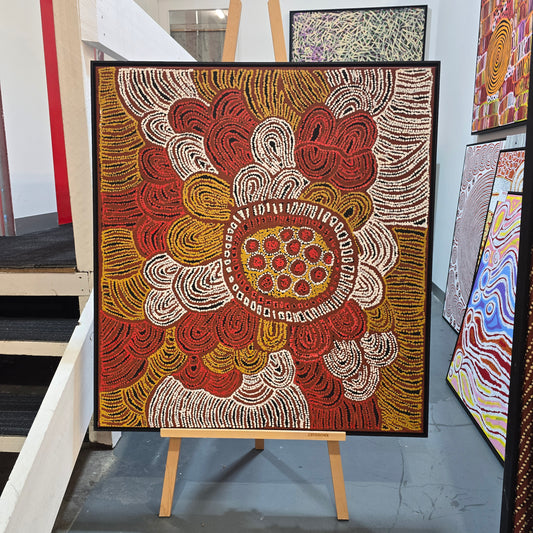
Fiona Porter 940 mm x 1080 mm
CODE : 8580Vendor:Fiona Young PorterRegular price $2,200.00 AUDRegular priceUnit price / perSale price $2,200.00 AUD -
Fiona Porter 940 mm x 1100 mm
CODE : 8597Vendor:Fiona Young PorterRegular price $2,300.00 AUDRegular priceUnit price / perSale price $2,300.00 AUD -
Fiona Young Porter 960 mm x 1040 mm
CODE : 8579Vendor:Fiona Young PorterRegular price $2,200.00 AUDRegular priceUnit price / perSale price $2,200.00 AUD
Quick Facts
Born: 1960s (exact year not publicly documented)
Place of Birth: Near Pungkupirri waterhole, Tjukurla, Western Australia
Language Group: Ngaanyatjarra
Art Style: Topographic desert painting with fine, rhythmic lines depicting dunes (tali), rock formations (puli), and ancestral tracks
Recognition: Renowned Ngaanyatjarra artist and cultural elder, exhibited nationally and internationally
Notable Presence: Works held by major collectors and leading Aboriginal art collectives
Fiona Young Porter (often referred to in the art world as Elsa Fiona Young) is a renowned Ngaanyatjarra artist whose art is an extensive aesthetic document of the Western Desert. Born in the 1960s around the Pungkupirri waterhole in Western Australia, she is an elder cultural figure whose paintings are renowned for their fine detail and rich spirituality.
Ancestral Lineage and Early Life
The artistic identity of Fiona cannot be discussed without referring to the glorious heritage of her family in the Australian Indigenous art movement. She is the daughter of the late Tjawina Porter Nampitjinpa, who is a legendary senior law woman and a painter.
Fiona was born in the remote area of Tjukurla, and ever since she was young, she was exposed to the traditional nomadic knowledge of her ancestors. Her family was moved to the Warburton Mission by Native Patrol officers in the 1960s, during a time of massive change, but which did not sever her connection to her "Country." She spent some time in Kaltukatjara (Docker River) and Warakurna before moving back to the newly formed community of Tjukurla, where she had raised her own family.
Artistic Style
Fiona Young Porter is known for a distinctive "topographic" style that bridges the gap between traditional iconography and contemporary abstraction. Instead of big dots, she tends to use fine, rhythmic lines, which follow the outlines of dunes (tali) and rock escarpments (puli). Her paintings serve as spiritual compasses, peering over the desert to show the underground tracks of the ancient beings. She employs a complex combination of earth colours, ochres, light pinks and deep charcoals to give out a visual vibration which resembles the desert heat.
The Tjukurrpa (Dreaming)
The core of Fiona’s practice is the preservation of the Tjukurrpa stories passed down through her maternal line. Many of her paintings focus on the sacred waterholes of Tjalili and Punkilpirri, which are vital life-sources in the arid desert. These works depict the ceremonies and travels of ancestral women, often using "U-shapes" to represent women sitting around a campfire or ceremonial site. The lines in her work represent the physical and spiritual "tracks" left by ancestors during the creation of the world, serving as a guide for future generations.
Professional Recognition
Fiona is a cornerstone of the Tjarlirli Art and Kaltukatjara Art collectives. Her work has gained significant international traction and is highly sought after by major collectors.
Her exhibitions include:
2023: Fisher’s Ghost Art Prize (Finalist) – Campbelltown Arts Centre, NSW.
2023: Ngurralampatju – Aboriginal Contemporary, Sydney.
2023: Really One Story: Art of the Ngaanyatjarra Lands – FORM Gallery, Perth.
2022: Desert Mob – Alice Springs, NT.
2022: Ngunytju Yuntalpa (Mother and Daughter) – Aboriginal Contemporary, Sydney.
2022: Tjarlirli Art – Spring 2022 – Yaamaganu Gallery, Moree.
2015: Revealed: Emerging Aboriginal Artists from WA – Fremantle Arts Centre, WA.
2015: Wintjiri Gallery – Ayers Rock Resort, NT.
2014: Living Spirit – Marshall Arts, Adelaide.
Legacy and Continued Practice
Fiona Young Porter contributes to the contemporary debate on the subject of Indigenous representation and self-determination in the wider context of Australian art. Her work challenges the idea that Indigenous art in Australia belongs only to the past or must follow a fixed visual style. Rather, she proves that indigenous art is modern, varied and always changing.
Fiona remains one of the most important people in her community today. She still paints frequently with her daughter, Deborah Young, who is also building a following as an artist. This three-generational family, starting with Tjawina through Fiona to Deborah, makes sure that the tales of the Tjukurla country are still a living, breathing component of the Australian contemporary art environment.
Young Porter offers creative control of Indigenous narratives by working in the manner that she has lived her life and believes in her values. This renders her practice not only artistic, but also cultural and political in its influence.
The work of Fiona Young Porter can be seen as a reflection of the Indigenous identity in the modern world. She uses material with caution, deeply rooted in culture, and devoted to the art of storytelling, making her art resonant with the whole world and personal.
Check out the Contemporary Art of Fiona with Mandel
Fiona’s work is part of an emerging genre of modern Indigenous art, which appreciates honesty, respect, and connection. By doing that, Fiona Young Porter is still influencing the way Indigenous voices are perceived and interpreted in the context of Australian art.
Check out her legacy at Mandel Aboriginal Art Gallery. Contact us or visit us for a detailed look at her masterpieces.