Collection: Billy Stockman Tjapaltjarri
-
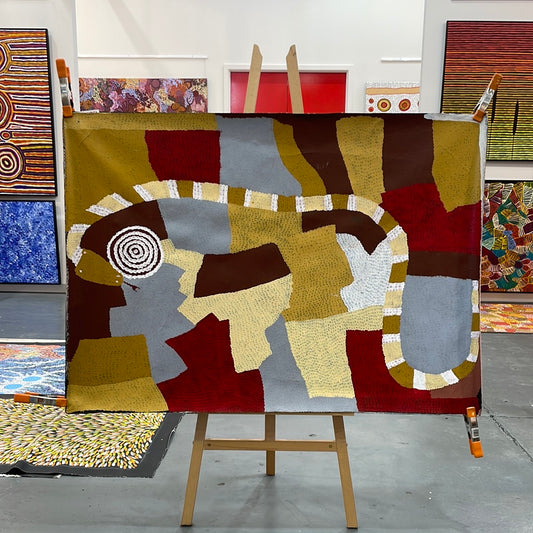
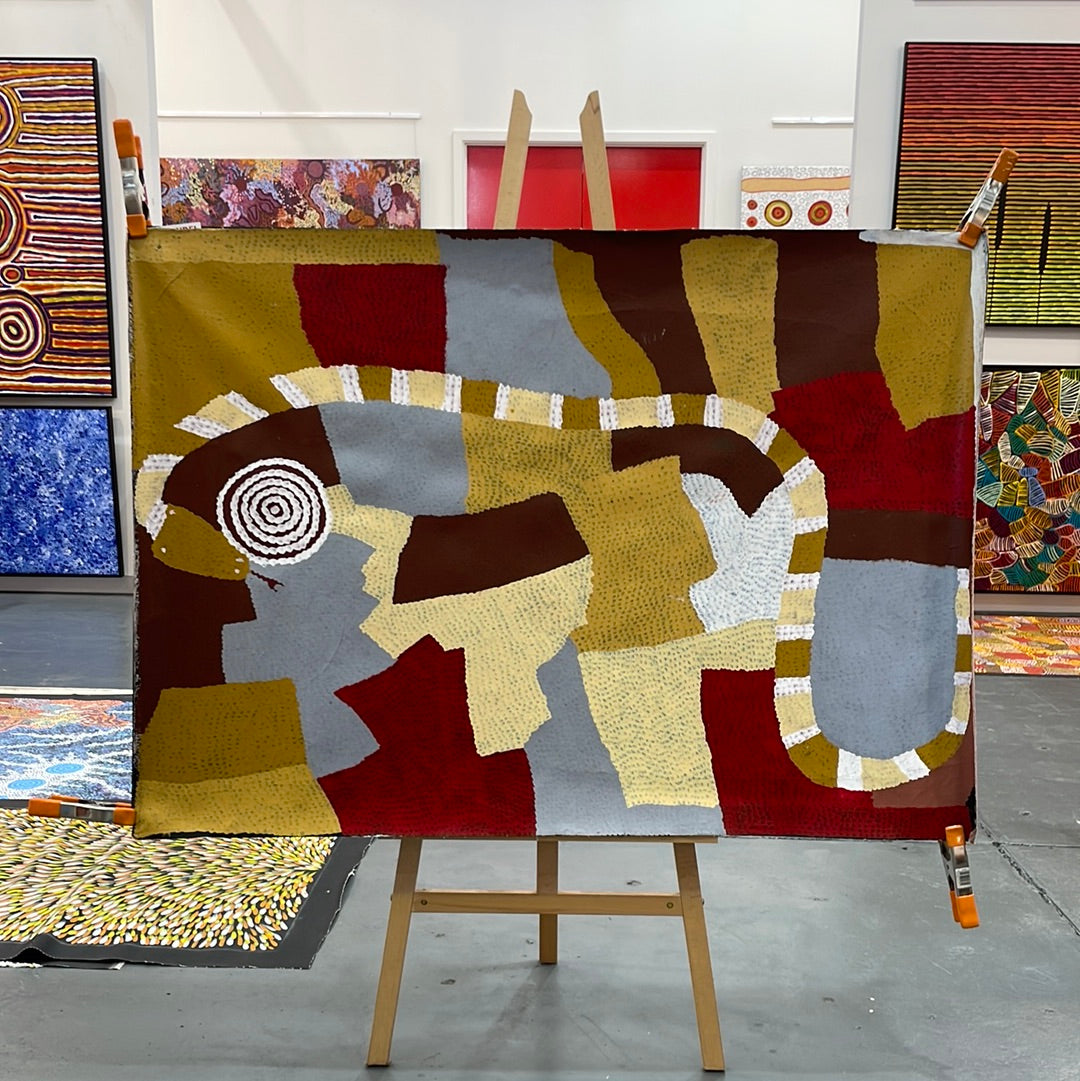
Billy Stockman Tjapaltjarri 940 mm x 1300 mm
CODE : 7938Vendor:Billy StockmanRegular price $14,900.00 AUDRegular priceUnit price / perSale price $14,900.00 AUD
Quick Facts:
Date of Birth: circa 1927
Place of Birth: Ilpili, west of Mount Leibig, Northern Territory
Language Group: Anmatyerre / Pintupi
Style of Art: Traditional Papunya Tula; dot painting and iconographic mapping
Aboriginal Art Status: Founding father of the Western Desert Art Movement
Billy Stockman Tjapaltjarri was among the most influential artists in the history of Australian Aboriginal art. Being one of the founding members of the well-known Papunya Tula Artists, he was at the core of the 1971 Western Desert art movement that saw the shift of Indigenous cultural expression beyond temporary sand and body markings to national and international prominence. His life marked the beginning of a traditional nomadic life to the frontline of the contemporary art world, which led him to be an important connection in the Australian cultural heritage.
Early Life and Survival
Born around 1927 at Ilpili, Billy Stockman’s early life was defined by the ancient rhythms of the Pintupi and Anmatyerre people. He spent his childhood leading a classic nomadic life, crossing the massive Western Desert, and learning how to survive and follow the sacred laws of his ancestors.
But he also experienced great tragedy in his youth since he was among the few who survived the Coniston Massacre of 1928, a violent act of colonisation which claimed the life of his mother. He was then brought up by his aunt, and he worked as a stockman, the origin of his European name, in the different stations, such as Narwietooma and Glen Helen, and ultimately settled at the government settlement of Papunya.
The Birth of a Movement
Billy Stockman became the focus of what is today known as the Big Bang of Aboriginal art in the early 1970s. He was among the first number of men who helped schoolteacher Geoffrey Bardon to paint the landmark Honey Ant Mural on the walls of the Papunya school. This was a revolutionary act since it was the first occasion when sacred Dreaming stories were expressed in a permanent, public medium.
Shortly thereafter, Billy was made founding chairman of Papunya Tula Artists, where he worked with legends such as Clifford Possum Tjapaltjarri to translate the traditional sand drawings and ceremonial designs into acrylic paintings on board and canvas.
Artistic Style and Technique
The artistic style of Billy Stockman was greatly influenced by the mapping of his ancestral Country, namely the "Dreaming" (Tjukurrpa) narratives of his father's land around the Ilpili and Ehrenberg Ranges. His art style is defined by high levels of symmetry and classical iconography, with U-shapes symbolising humans and concentric circles symbolising sacred waterholes or campsites.
Over his decades-long career, his technique evolved from figurative narrative compositions to a more refined and dense dotting style. These later works are celebrated for their rhythmic patterning and visual intensity, using a palette that shifted between traditional earth ochres and more contemporary, vibrant tones to capture the spiritual depth of the landscape.
Themes: The Wild Potato and Budgerigar Dreamings
The heart of Billy's portfolio was on particular Dreamings of which he was the main custodian, the most renowned of which were the Yala (Wild Potato) and the Nyingka (Budgerigar) Dreaming. His paintings are spiritual maps, which follow the paths of the ancestral creatures in the desert and explain how the major geographical features were created.
Rather than being mere landscapes, these works are profound cultural documents that record the location of vital resources like soakages and the spiritual significance of various rock formations. Through these themes, Billy communicated the enduring connection between his people and the land, ensuring these stories remained vibrant for future generations.
Legacy and Global Recognition
Even during his glamorous career, Billy Stockman never ceased to be an ardent champion of his culture, and in 1988, he even travelled to the United States to popularise the Papunya Tula movement. His work is also housed in the most respected world museums such as the National Gallery of Australia, the Musée du quai Branly in Paris and the Metropolitan Museum of Art in New York.
In 2004, his status as a master artist was formally recognised when he received the prestigious National Aboriginal and Torres Strait Islander Art Award (NATSIAA). His death in 2015 left behind him a legacy that has seen Aboriginal art morph into a world-renowned movement without in any way losing the absolute integrity of its original nature.
Billy Stockman Tjapaltjarri was not only an artist, but he was also a cultural pioneer and made the Australian landscape his canvas of international importance. His work continues to provide a window into the spiritual world of the Western Desert, blending historical resilience with creative innovation. As a founding father of the movement, his influence remains a cornerstone of the contemporary Indigenous art scene.
Discover the Collection at Mandel Aboriginal Art Gallery
Discover the legacy of Billy Stockman Tjapaltjarri by exploring collections and exhibitions that feature his work. Learn about the origins of the Papunya Tula movement and the stories that shaped modern Aboriginal art.
Explore authentic contemporary Aboriginal paintings and discover the stories that shaped a global art movement. Visit Mandel Aboriginal Art Gallery today to experience the creativity and culture of Indigenous Australia.